 Enzo Audio Visual
Fiber Optic Statistics: Phoenix, AZ (2026)
Fast and reliable connectivity isn’t just riding a national trend in Phoenix right now, it’s riding the biggest tech buildout in Arizona history. TSMC alone has committed $265 billion to its north Phoenix campus. Data center capacity in the Valley is on pace to nearly double by 2030. And underneath every one of those projects sits the same unglamorous requirement: enough fiber, run correctly, to carry the load.
For a business owner managing an office downtown, a retail space in Arcadia, or a facility near the warehouse districts by Sky Harbor, that boom isn’t background noise. It’s changing what “adequate” network infrastructure means for a normal commercial space competing for talent, uptime, and bandwidth in the same regional economy as hyperscale data centers.
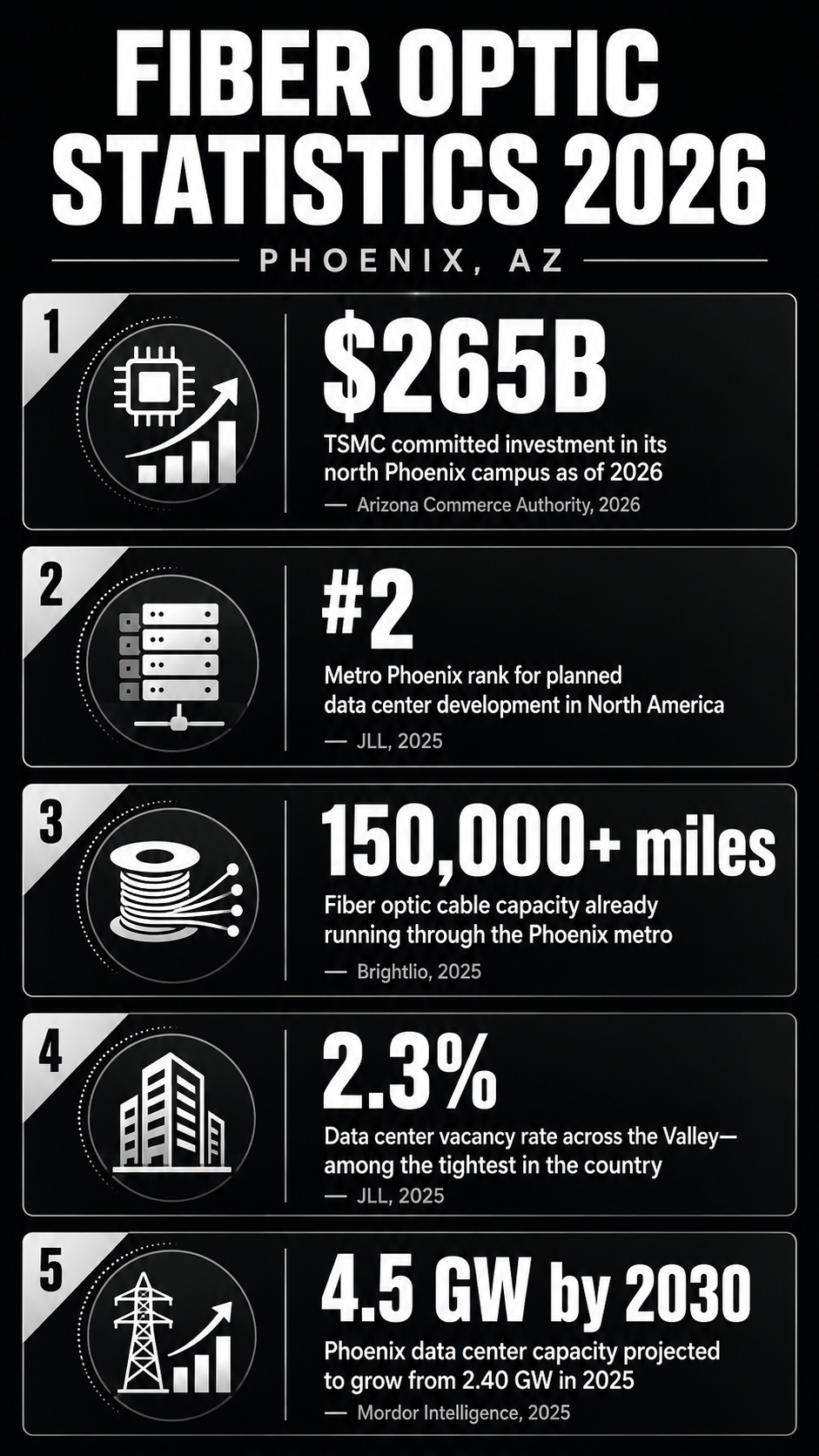
Fiber Optic Statistics for Phoenix in 2026: What To Know
Here are the numbers behind the Valley’s fiber buildout, and what they mean for a typical Phoenix business.
- $265 billion — TSMC’s total committed investment in its north Phoenix campus as of July 2026, spanning 10 fabs and two advanced packaging facilities. (Arizona Commerce Authority, 2026)
- #2 in North America — Metro Phoenix’s rank for planned data center development, behind only Northern Virginia. (Arizona Corporation Commission, citing JLL, 2025)
- 150,000+ miles — Fiber optic cable capacity already running through the Phoenix metro. (Brightlio, 2025)
- 2.3% — Data center vacancy rate across the Valley, among the tightest in the country. (Arizona Corporation Commission, citing JLL, 2025)
- $16.29 billion — Size of the global structured cabling market in 2026, growing roughly 10% a year. (Research and Markets, 2026)
- 226,800 jobs — Arizona’s construction workforce as of December 2025, up nearly 6,000 workers year over year. (AZ Big Media, citing LGE Design Build, 2026)
- 124% — Median two-year revenue growth among Phoenix-area companies on the 2026 Inc. Regionals fastest-growing list. (Inc., 2026)
Phoenix Is Becoming a National Fiber and Data Hub
The scale of Arizona’s tech investment is hard to overstate. TSMC’s additional $100 billion commitment brings its total Arizona investment to $265 billion across 10 fabs, two advanced packaging facilities, and an R&D center. The buildout is expected to create roughly 80,000 jobs over five years and position Arizona to produce a fifth of the world’s most advanced semiconductors. Since 2020, Arizona has attracted more than 70 semiconductor-related expansions representing over $314 billion in investment, the most of any state.
Data centers are following the same trajectory. Metro Phoenix ranks second in North America for planned data center development, behind only Northern Virginia, with local vacancy at just 2.3% and the project pipeline more than tripling since 2020. The Phoenix data center market is projected to grow from 2.40 gigawatts in 2025 to 4.5 gigawatts by 2030, an 18.5% annual growth rate.
None of this happens on wireless alone. Companies are drawn to Phoenix for cheap electricity, predictable weather risk, and, critically, the region’s position on a major fiber-optic backbone running from Texas to Southern California. The Phoenix metro already carries more than 150,000 miles of fiber optic capacity, giving it low-latency connectivity to Silicon Valley, Los Angeles, Dallas, Denver, and beyond.
For a Phoenix business, this means fiber backbone options and installer talent are unusually strong for a metro this size. It also means demand for skilled cabling and termination work is climbing fast, so project timelines with generalist contractors can stretch out.
Why Fiber Wins in a Desert Climate
Extreme heat shapes almost every infrastructure decision in the Valley, and fiber has real physical advantages over copper. Fiber optic cables consume less power and generate less heat than copper cables, which improves energy efficiency, a meaningful factor when ambient summer temperatures push HVAC and cooling systems to their limits inside a commercial building or server closet.
Because fiber carries data as light rather than electrical current, it generates almost no heat and produces no electromagnetic interference with nearby cabling, a real advantage for businesses running dense runs of security camera, access control, and network cabling through the same conduit. Fiber also delivers far greater bandwidth with lower signal loss over distance than copper can match once a building’s electrical load, and Phoenix’s summer grid strain, starts to climb.
In a market where summer highs regularly clear 110°F and commercial HVAC is already a top line-item expense, cabling that runs cooler and needs less climate-controlled babysitting isn’t a nice-to-have. It’s a direct line to lower operating costs.
Commercial Construction and Office Demand Are Both Climbing
Phoenix’s broader commercial real estate market gives useful context for why more businesses are upgrading network infrastructure right now, not later. Office sales in metro Phoenix totaled $521 million through the first five months of 2026, trailing only San Francisco, the Bay Area, and Los Angeles among Western markets, while vacancy fell to 16.4%, well below the 17.6% national average. Industrial net absorption jumped 107% year over year in the first quarter of 2026, reaching 3.0 million square feet.
At the same time, Arizona’s construction workforce grew to 226,800 jobs by December 2025, a gain of nearly 6,000 positions over the year, concentrated in building construction and specialty trades across the Phoenix metro. That’s a labor market being pulled in two directions: standard commercial buildouts on one side, and data center-scale specialty cabling work on the other, both competing for the same skilled electricians and low-voltage technicians.
Businesses renovating or relocating into Phoenix office and industrial space are increasingly finding that structured cabling and fiber runs are now the long lead-time item in a buildout, not the afterthought, because the same trades pool is also staffing hyperscale data center jobs across town.
The National Cabling Market Is Shifting Toward Fiber
The global structured cabling market is valued at $16.29 billion in 2026 and is projected to reach $23.82 billion by 2030, growing roughly 10% a year, driven largely by data center expansion and rising bandwidth demand. Fiber optics is projected to account for over 40% of that market by 2026, even though copper still holds roughly 56% of installed cabling overall, remaining the standard for local area networks and Power over Ethernet.
The reason fiber keeps gaining share even where copper is entrenched comes down to AI-era bandwidth: AI workloads require more than 10 times the fiber density of traditional data center builds, and demand is intensifying further as 800G and 1.6-terabit optical interconnects roll out.
The same AI-driven fiber demand curve pushing hyperscale builds is trickling down to ordinary commercial buildings. Video conferencing, multi-site AV distribution, cloud-based POS and security systems, and high-density Wi-Fi access points are all quietly raising the bandwidth floor for a normal Phoenix office or retail space.
Population and Business Growth Keep Raising the Bandwidth Floor
Growth in the Valley isn’t just about chip fabs and data centers, it’s also about the sheer number of new residents and new companies straining local networks. Maricopa County’s population grew 7.9% between 2020 and 2025 to reach nearly 4.79 million people, and Arizona added more than 97,000 residents between mid-2024 and mid-2025 alone, a 1.2% growth rate, with Maricopa County ranking first in the nation for net migration the year before.
That growth feeds directly into new business formation: Phoenix-metro companies named to the 2026 Inc. Regionals list posted a median two-year revenue growth rate of 124% across industries from food service to IT. Every new resident and every fast-growing local company is another set of devices, cameras, and connections competing for bandwidth on aging office and retail cabling that, in many cases, was installed a decade or more before anyone anticipated 2026-level demand.
Summary Table
| Statistic | Figure | Source | Year |
|---|---|---|---|
| TSMC total Arizona investment | $265 billion | Arizona Commerce Authority | 2026 |
| TSMC current AZ employment | 3,500+ | KJZZ | 2026 |
| Phoenix data center rank (North America) | #2 | Arizona Corporation Commission / JLL | 2025 |
| Phoenix data center vacancy rate | 2.3% | Arizona Corporation Commission / JLL | 2025 |
| Phoenix data center capacity, 2025 to 2030 | 2.40 GW → 4.5 GW (18.5% CAGR) | Mordor Intelligence | 2025 |
| Fiber optic capacity in Phoenix metro | 150,000+ miles | Brightlio | 2025 |
| Global structured cabling market size | $16.29 billion | Research and Markets | 2026 |
| Fiber optic share of structured cabling market | 40%+ | Technavio | 2026 |
| Extra fiber density required for AI workloads | 10x traditional data centers | Persistence Market Research | 2026 |
| Arizona construction workforce | 226,800 jobs (+6,000 YoY) | AZ Big Media / LGE Design Build | 2025 |
| Phoenix office sales, Jan to May 2026 | $521 million | AZ Big Media | 2026 |
| Phoenix office vacancy rate | 16.4% | AZ Big Media | 2026 |
| Phoenix industrial net absorption, Q1 2026 | 3.0 million sq ft (+107% YoY) | Cushman & Wakefield | 2026 |
| Arizona semiconductor expansions since 2020 | 70+ ($314 billion total) | Arizona Commerce Authority | 2026 |
| Maricopa County population (2025) | ~4.79 million (+7.9% since 2020) | AZ Economics | 2025 |
| Arizona population growth, mid-2024 to mid-2025 | +97,044 residents (1.2%) | Arizona Commerce Authority | 2025 |
| Phoenix fastest-growing companies, median revenue growth | 124% (2022-2024) | Inc. Regionals | 2026 |
FAQ: Fiber Optic Statistics for Phoenix Businesses
What is the average data center vacancy rate in Phoenix?
Roughly 2.3%, among the tightest in North America, reflecting intense demand for space on the Valley’s fiber-connected infrastructure. (Arizona Corporation Commission, citing JLL, 2025)
How much is TSMC investing in Phoenix, and why does it matter for local businesses?
TSMC’s total committed Arizona investment stands at $265 billion as of July 2026. The buildout is drawing skilled electrical and low-voltage trades into large-scale projects, which is tightening the labor market for commercial cabling work across the metro. (Arizona Commerce Authority, 2026)
Is fiber optic cabling better than copper for Phoenix’s climate?
Fiber generates less heat and draws less power than copper, and it’s immune to the electromagnetic interference that can affect dense cable runs in commercial buildings, both meaningful advantages in a market with high summer cooling costs. (Hexatronic; Photonics Explained, 2026)
How big is the structured cabling market in 2026?
The global market is valued at $16.29 billion in 2026, growing roughly 10% annually, with fiber optic systems projected to account for more than 40% of that market. (Research and Markets; Technavio, 2026)
How fast is Phoenix’s commercial real estate market growing?
Office sales hit $521 million in the first five months of 2026 alone, and industrial net absorption grew 107% year over year in Q1 2026, both signs that businesses are actively building out or relocating into space that needs modern network infrastructure. (AZ Big Media; Cushman & Wakefield, 2026)
Methodology & Sources
Compiled by the Enzo Audio Visual Team, July 2026. Every statistic above is drawn from named, publicly available sources, including the Arizona Commerce Authority, the Arizona Corporation Commission (citing JLL’s North American Data Center Report), Mordor Intelligence, Research and Markets, Technavio, Persistence Market Research, AZ Big Media, Cushman & Wakefield, Inc. Regionals, AZ Economics, KJZZ, and Hexatronic and Photonics Explained for fiber-versus-copper performance data. Full links are included above wherever a specific figure is cited.
Building for What’s Coming to the Valley
Is your building’s cabling ready for Phoenix’s next phase of growth? Enzo Audio Visual designs and installs commercial fiber optic and structured cabling systems for offices, retail spaces, and industrial facilities throughout the Phoenix Valley. If your network is still running on infrastructure built for a smaller, slower Phoenix, contact us today at (602) 769-7992 to schedule a consultation.