What to know about commercial audio in Phoenix
Downtown outdoor amplified music stops early
Under the Downtown Code, no one may use amplified music or loudspeakers outside after 8 p.m. on Sundays or after 10 p.m. on Fridays and Saturdays, unless the property holds a use permit. The condition applies to uses whose land use entry cites it, so we confirm yours with Planning & Development.
55 dBa at the neighbor's property
The same Downtown condition caps noise measured at the received property at 55 dBa unless a use permit says otherwise. Speaker aim and a locked maximum level become part of the design.
Walkable urban districts have their own hours
In the Transect districts, outdoor entertainment must end at 11 p.m. Monday through Saturday and 10 p.m. on Sunday. Outdoor amplified music ends at 8 p.m. Monday to Thursday and Sunday, and 10 p.m. Friday and Saturday, unless you have a use permit. Transect districts are a limited set of mapped areas, so we check your parcel.
No citywide decibel number, but a loud-noise ban
Phoenix City Code bans unreasonably loud, disturbing and unnecessary noise citywide, and that section gives no decibel figure. It names music that disturbs neighbors, particularly from 11 p.m. to 7 a.m., as a violation.
Zones: who hears what
Most restaurants want at least three zones: dining room, bar and patio. Restrooms and entries often get their own. Each zone has its own volume and can play its own source, so the bar runs game audio while the dining room stays on background music.
Staff run the zones from a wall panel or an app. We set a maximum level on each zone, so a busy Friday doesn't end with the patio turned all the way up.
Speaker types
In-ceiling speakers keep a dining room clean. Surface-mount speakers work where there's no ceiling space, and pendants suit open ceilings and warehouse-style rooms. A bar with a crowd usually needs a subwoofer, which keeps the music full without pushing the main speakers.
- Many small speakers at a low level sound better than a few loud ones.
- Long runs with many speakers often use a 70-volt system, which keeps the wiring simple.
- Outdoor speakers need to be rated for sun, heat and dust, which a Phoenix patio has plenty of.
Patio and rooftop sound in Phoenix
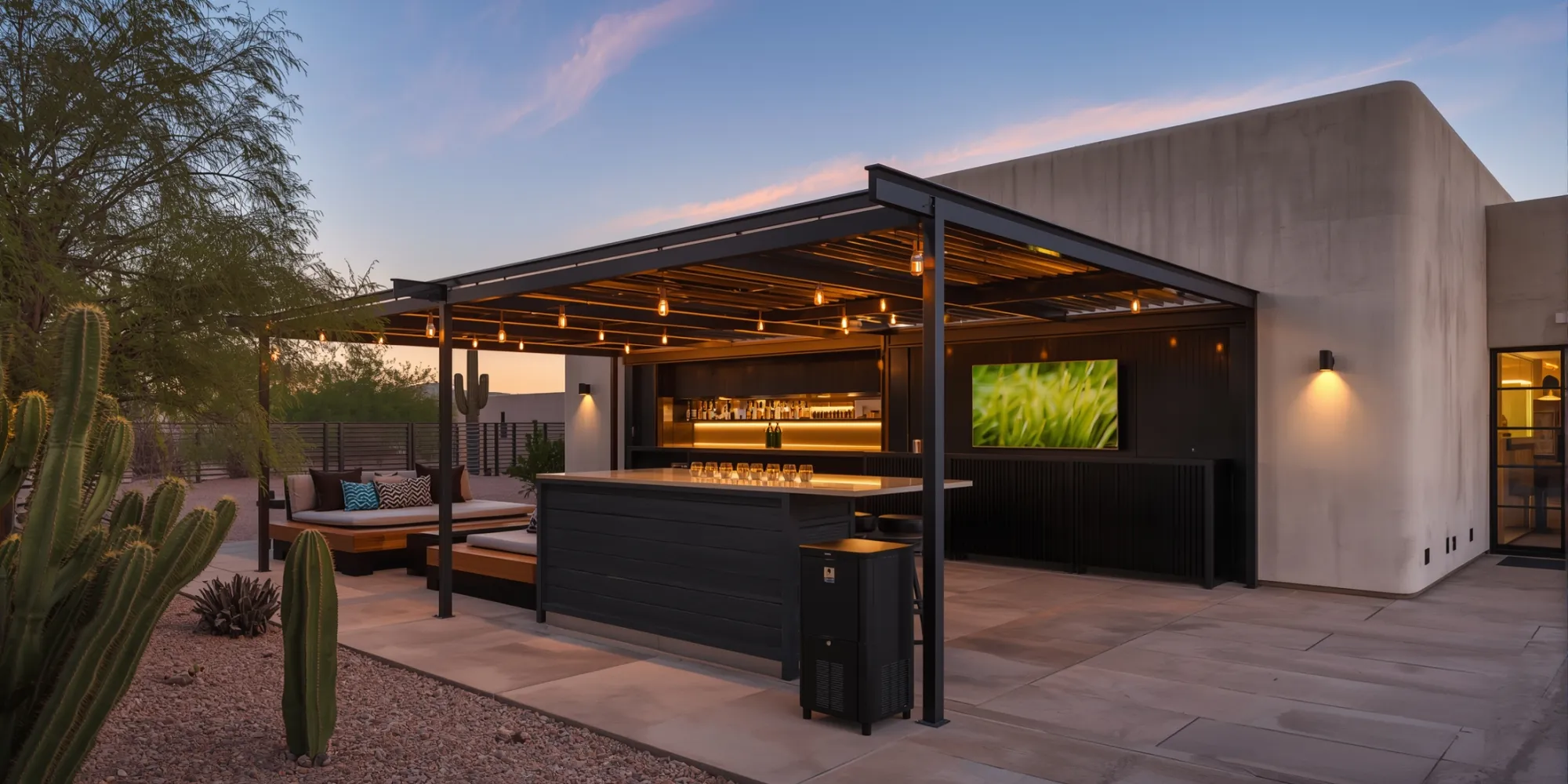
Phoenix patios fill up from fall to spring, and the neighbors are often right behind the fence. We aim speakers down into your seating, keep them off the property line, and lock the maximum level in the amplifier instead of leaving a knob anyone can turn.
A timer can drop a patio zone to background level, or mute it, at the hour your rules require. A downtown Phoenix bar approved in October 2025 for outdoor music had its speaker count, setbacks and a 55 dBa property-line limit written into the approval. If your use permit lists a speaker count or setback, we build the layout to match and give you the plan to keep on file.
Amplifiers and the rack
Behind the speakers sits a multi-channel amplifier with built-in processing, which lets us tune each zone to its room. Everything lands in a labeled rack, so the next service call is quick. Equipment you already own stays in the system when it still works.
How the install goes
Phoenix limits building work within 500 feet of an inhabited structure to set hours, with a permit possible for other hours, and summer hours differ from winter ones. Drilling and other noisy work get scheduled inside those hours and around your service.
- Walkthrough of the rooms, ceilings and cable paths.
- A plan with zones, speaker positions and a quote.
- Installation, usually after hours or on a slow day so you stay open.
- Tuning each zone, then showing your staff how to run it.
- Service is available Monday to Friday, 8 AM to 5 PM.
Often paired with
In bars, audio usually goes in with TV and video distribution, and venues that host nights out add event audio and video. AV control systems put all the zones on one panel. The rest of our Phoenix work is on the Enzo in Phoenix page.