What to know about TV and video distribution in Phoenix
Downtown game nights come in waves
The city names the Phoenix Convention Center, Chase Field and Mortgage Matchup Center as Downtown's entertainment anchors. Bars near them can see a whole crowd change channels at once when a game ends, so the system has to switch every screen at the same moment.
Source: City of Phoenix, Downtown Entertainment District Implementation Plan (April 2026)
A TV near the glass can count as a window sign
Phoenix defines a window sign as one inside a building within six feet of a window and meant to attract people outside. The sign code also defines a sign as anything that identifies or directs attention to a business, product or activity. It doesn't say how it treats a live game on a window TV, so we ask the Sign Section at 602-495-0301 before hanging a screen that faces the street.
Most video wiring is low voltage
Phoenix exempts Class 2 and Class 3 control and signal circuits from electrical permits unless they are essential for life safety. Communications wiring run inside a building is still covered by the building code, so on larger remodels we check the scope with plan review.
New plans follow the 2024 Phoenix code
The 2024 Phoenix Building Construction Code took effect August 1, 2025, and every plan submitted after December 31, 2025 must meet it. On a tenant improvement, TV mounts, power and ceiling work follow that edition.
One rack, every screen
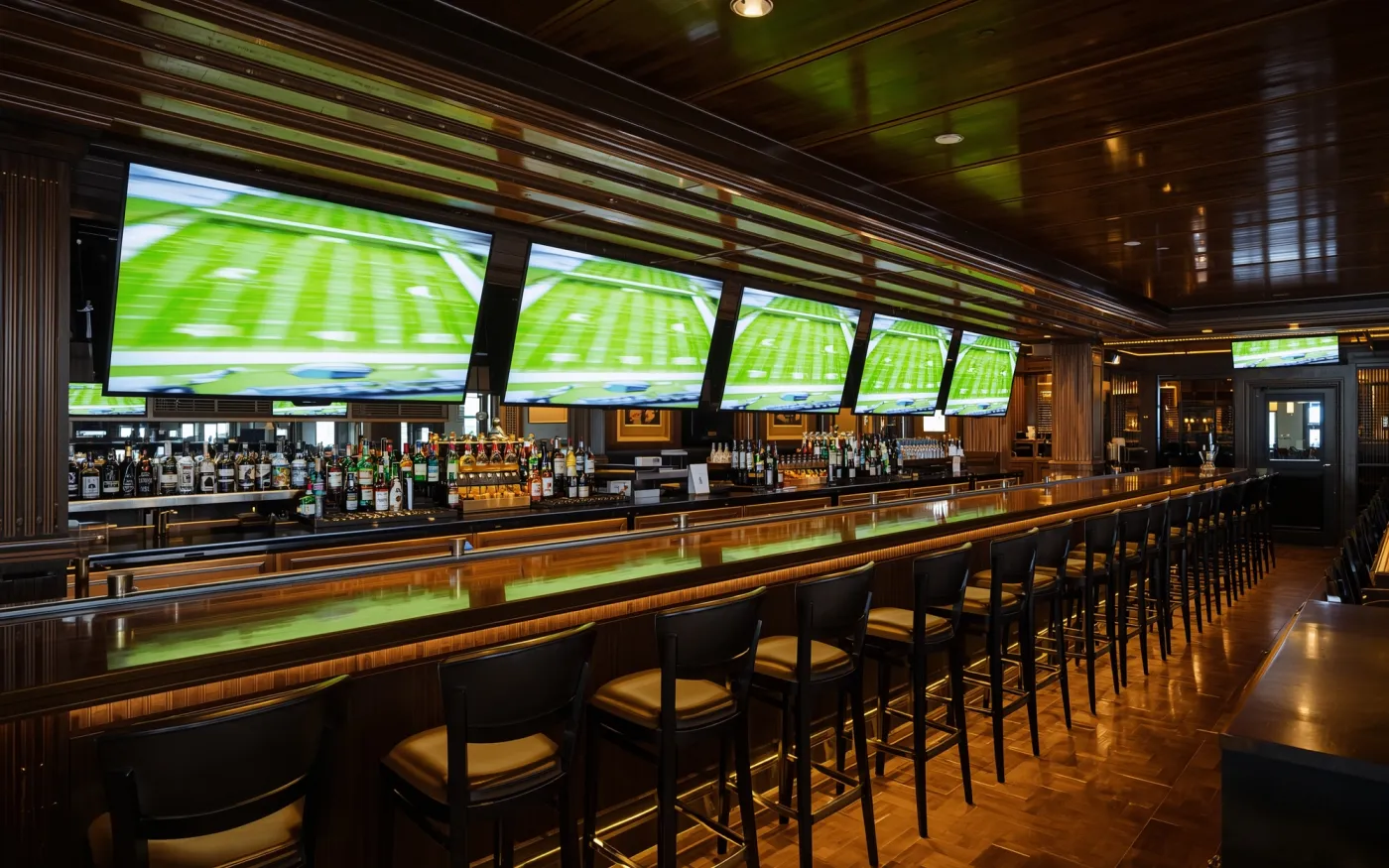
Without distribution, each TV needs its own cable box and remote, and staff spend the first quarter of every game walking the room. With it, the sources sit in one rack and a signal runs to each screen. Staff pick what each TV shows from a tablet or wall panel.
You decide which TVs show which game, which stay on the music video loop, and which go dark at close.
Matrix switcher or video over IP
Two designs are common. A matrix switcher takes sources in and sends them out over HDMI or HDBaseT cable to each screen. It's simple and fast, and it suits rooms up to a few dozen TVs. Video over IP sends the signal across your network switches, which scales to many more screens and keeps cabling lighter.
- Matrix switcher: dedicated cable runs, near-instant switching, easier to troubleshoot.
- Video over IP: standard network cable, more screens, needs a well-planned network.
- Either way, every source gets a label and every TV gets a name staff recognize.
Sources, screens and audio
A sports bar usually runs several cable or satellite boxes and a few streaming devices. The boxes mount in the rack, power on a schedule, and get remotes wired so they work without line of sight. TVs are commercial-grade where hours justify it, and each one turns on and off with the system.
Game audio can go to one zone while the rest of the room keeps its music. Tied to commercial audio, that puts the play-by-play in the bar and keeps it out of the dining room.
Downtown Phoenix and the game-day crowd
Venues near Chase Field and the City-owned arena at 201 E Jefferson St can have their busiest hours packed into short windows. We size the rack and network for that peak, not an average Tuesday, and leave a spare input free so a new channel or streaming box doesn't mean reworking the rack.
Install steps
- Count screens, mark sight lines and trace cable paths.
- Write up the source list, screen list and rack layout, then quote.
- Mount and cable, usually before open or on a slow day.
- Program the panel, name every TV and test every source.
- Walk your staff through it. Service runs Monday to Friday, 8 AM to 5 PM.
Often paired with
Video usually goes in with commercial audio and an AV control system, so one panel runs both. Venues with a big screen may add an LED video wall. The Enzo in Phoenix page covers the rest.