What to know about commercial audio in Surprise
Surprise judges music by who it disturbs, not by decibels
The sections of the code we read set no decibel limit for businesses. They ban music from a restaurant, hotel, store or place of entertainment that is loud or unusual enough to disturb the peace and quiet of a considerable number of people in the neighborhood. That is a judgment call, not a meter reading, so the system has to keep the level where you set it.
A violation is a criminal charge
Every violation of Sec. 34-105 is a class 1 misdemeanor. The same section covers a radio, stereo or television played at an unreasonably loud volume, inside a building or out. We treat a locked maximum level as part of the install.
Outdoor concerts need a temporary use permit
Concerts and other outdoor live entertainment need a temporary use permit in Surprise. The city's list of events that don't need one includes indoor live entertainment that is ancillary to a restaurant.
Source: City of Surprise, Land Development Ordinance Chapter 106 (temporary uses)
Patio rules cover the footprint, not the speakers
A patio must be on private property, may extend up to 10 feet into a setback but stay at least 5 feet from the property line, and counts as part of the premises for liquor-license spacing. That section has no speaker rule, so noise falls under Sec. 34-105. A separate PDF of proposed amendments renumbers this section, so confirm the current numbering.
Source: City of Surprise, Land Development Ordinance Chapter 106
Zones: who hears what
Most restaurants want at least three zones: the dining room, the bar and the patio. Restrooms and entries often get their own. Each zone has its own volume and usually its own source, so the bar can run game audio while the dining room stays on background music.
Staff control the zones from a wall panel or an app. We set a maximum level on each zone, so a busy Friday doesn't end with the patio turned all the way up.
Speakers that suit the room
In-ceiling speakers keep a dining room clean. Surface-mount speakers work where there is no ceiling space, and pendants suit open ceilings and warehouse-style rooms. A bar with a crowd usually needs a subwoofer, so the music stays full without pushing the main speakers.
- Many small speakers at a low level sound better than a few loud ones.
- Long runs with lots of speakers often use a 70-volt system, which keeps wiring simple.
- Outdoor speakers need to be rated for sun, heat and dust, which matters in a Surprise summer.
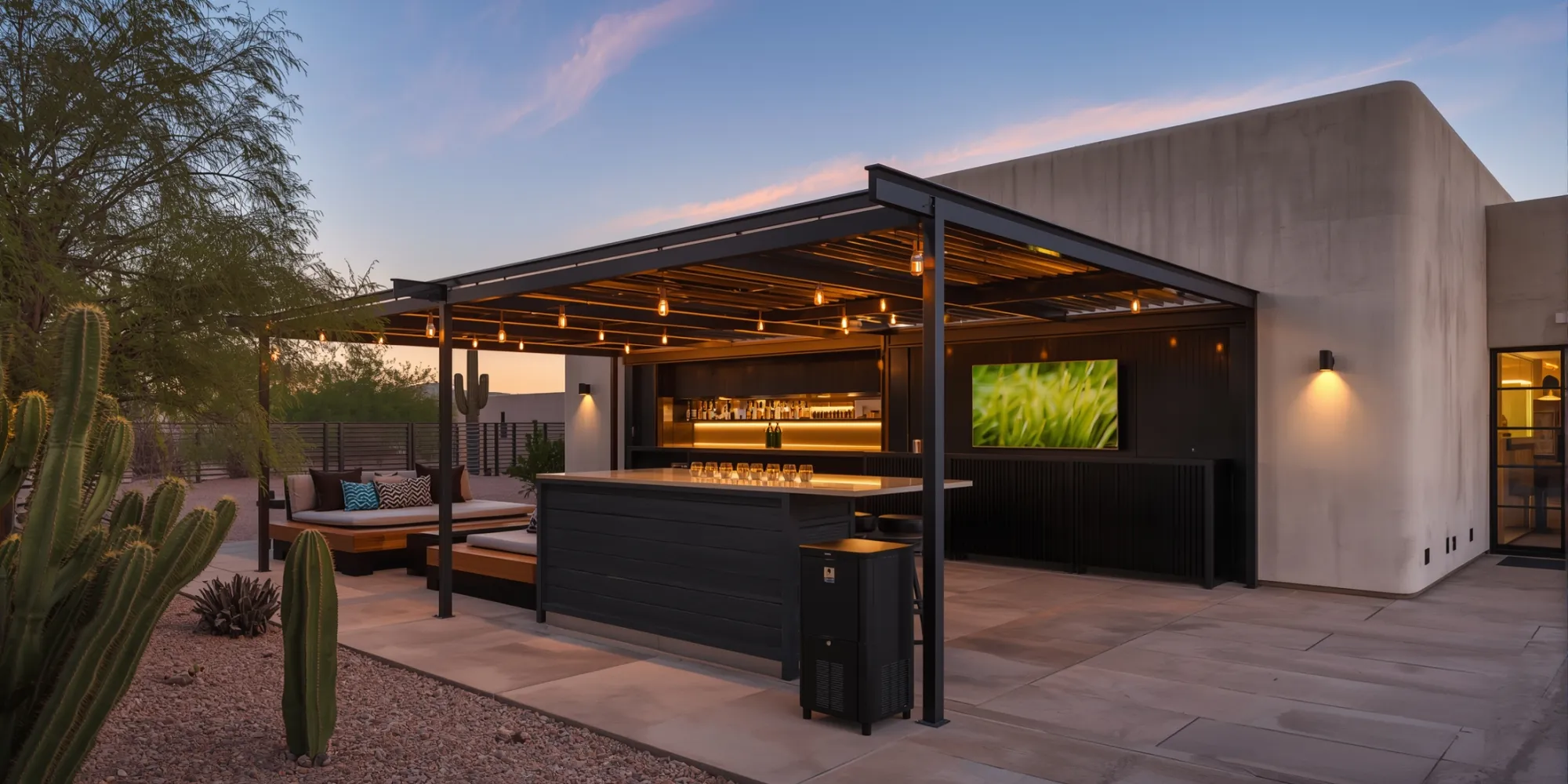
Patio sound in Surprise
Because the test is whether neighbors are disturbed, where the sound goes matters more than how loud the amplifier can get. We aim patio speakers down and toward your seating, away from the property line, and use more speakers at lower levels so the sound doesn't throw far.
Then we lock the patio's maximum level in the amplifier instead of leaving a knob anyone can turn. We also leave staff a simple rule: walk to the property line at the busiest hour and listen. If the music is clear there, turn the zone down.
Amplifiers and the rack
Behind the speakers sits a multi-channel amplifier with built-in processing, which lets us tune each zone for the room. Everything lands in a labeled rack, so the next service call is quick. We can also connect to your existing equipment when it still works.
Install, tuning and handover
- A walkthrough of the rooms, ceilings and cable paths.
- A zone plan with speaker locations, and a written quote.
- The install, usually after hours or on a slow day so you stay open.
- Tuning each zone, locking maximum levels and showing staff how to run it.
- Service after the install runs Monday to Friday, 8 AM to 5 PM.
Often paired with
In bars, audio goes in with TV and video distribution. Guest WiFi and security cameras share the same network, and a single control panel can run music, TVs and lights together. More on Enzo in Surprise.