What to know about LED video walls in Phoenix
A lit wall that shows your business can be a sign
Phoenix defines a sign as anything that identifies or directs attention to a product, place, activity, person or business. A wall showing your name or offers to the street meets that. The code doesn't say how it treats a live game on a TV, so we ask the Sign Section at 602-495-0301.
Electronic message displays need a use permit
Phoenix defines an electronic message display as any sign whose words or images can change electronically. It's allowed in commercial and industrial land use designations, only with a use permit, and only on property next to a freeway or a major arterial, arterial or collector street. It must also sit at least 100 feet from flashing warning signs like school crosswalk, train crossing and fire station signals.
Brightness, timing and the 11 p.m. shutoff
An electronic message display needs a photocell that dims it to the ambient light, and it may not exceed 300 nits from dusk until dawn. Each message must hold at least eight seconds and switch instantly, with no flashing or moving lights. If it sits within 150 feet of single-family zoning and is visible from it, it can't be lit from 11 p.m. to sunrise.
Permit fees and conditions can add up
The fee schedule effective January 20, 2026 lists $195 per sign for the electric component inspection, and sign plan review is billed at $195 per hour with a one-hour minimum. We re-check the fee schedule before you commit.
Indoor walls and outdoor walls
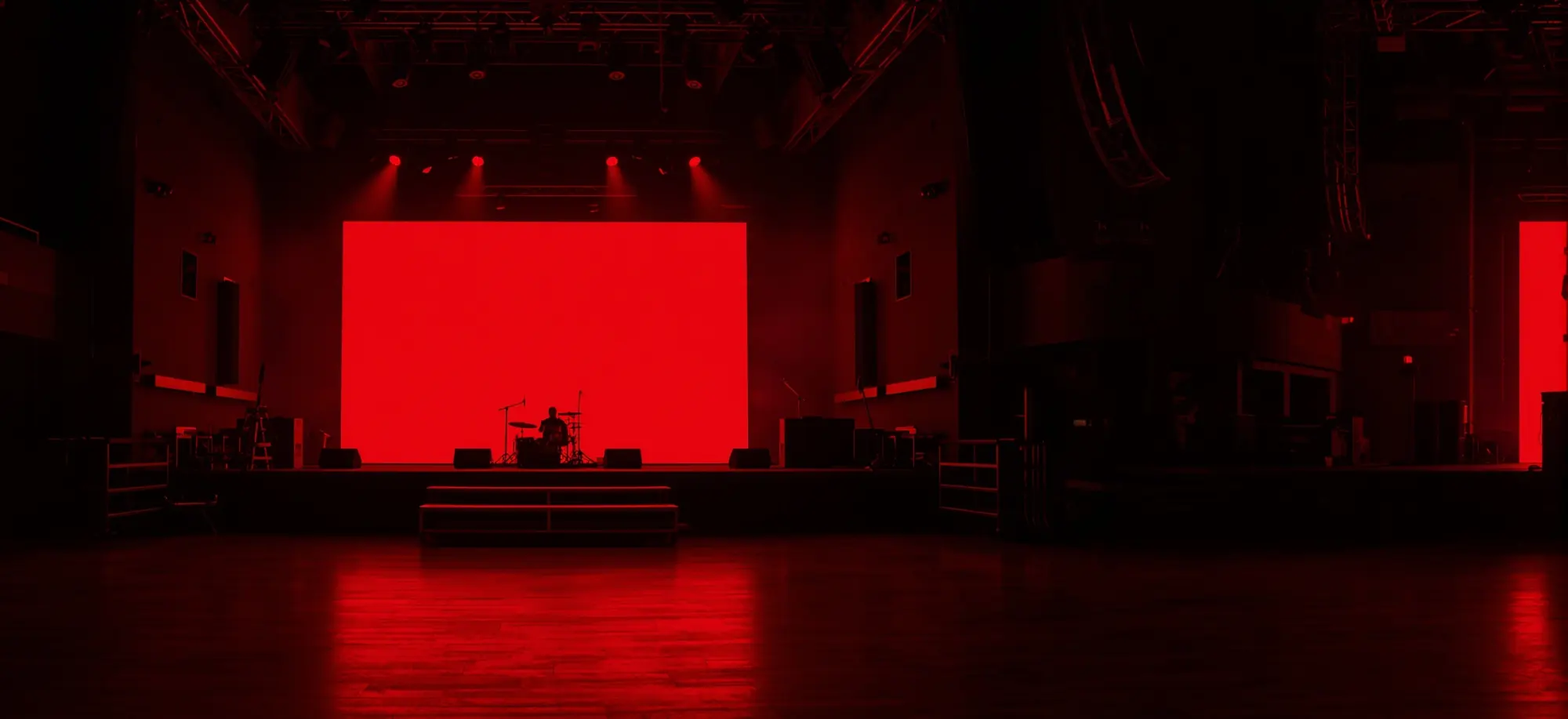
A wall behind a stage or inside a lobby, where no one outside can see it, is a different job from a wall facing a street. Indoor walls come down to pixel pitch, content and rigging. Anything the street can see also has to meet the sign rules above, so the permit gets sorted first and panels get ordered second. In a July 30, 2026 approval, a hearing officer capped an electronic display at 22 square feet and required it to shut off automatically at 9 p.m. daily, so conditions can go beyond the code.
Pixel pitch and viewing distance
Pixel pitch is the distance between LEDs, in millimeters. A smaller number gives a sharper picture and costs more. As a rough rule, the closest viewer should stand a few meters away for each millimeter of pitch. A lobby people walk up to needs fine pitch, and a stage wall seen from across a room can use coarser.
- Fine pitch for lobbies, bars and anything within arm's reach.
- Coarser pitch for stages, patios and large rooms.
- Outdoor panels need a higher brightness rating and a weatherproof build, which Phoenix sun demands.
Phoenix sun and heat
Phoenix daytime sun washes out a dim screen, and the city caps a lit sign at 300 nits from dusk to dawn. A photocell solves both: bright enough to read at noon, dimmed at night as the code requires. Heat is the other half. Walls need airflow or cooling in a rack or enclosure, and outdoor panels need a rating for desert temperatures.
Frame, power and processor
A wall needs a frame that holds its weight, dedicated power circuits and a video processor that scales your content to the wall. Your electrician handles the power and we coordinate with them, and we do the data side. You change content from a laptop or a schedule, and we show your staff how to switch scenes.
From site visit to calibration
- Visit the site to measure the wall, check structure and power, and read the sign rules for your address.
- Plan panel size, pitch and frame, then quote, with the permit steps.
- Build the frame, power and data first, then hang panels.
- Calibrate so color matches across the wall.
- Train your staff. Service runs Monday to Friday, 8 AM to 5 PM.
Often paired with
Walls usually go in with commercial audio and an AV control system, and venues that book shows add event audio and video. Storefront screens are covered under digital signage. The Enzo in Phoenix page lists the rest.