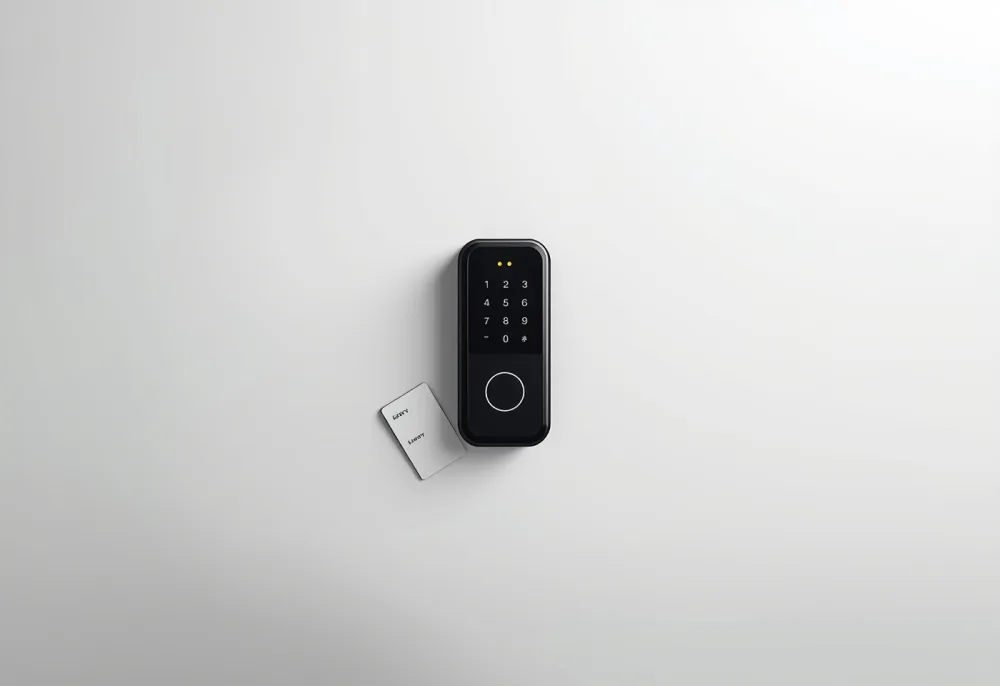
What to know about door access control in Peoria
Access-controlled gates need a way for Fire-Medical to get in
Peoria's amended fire code says all gates limiting access must provide emergency access controls for Fire-Medical Department entry, and gate plans go to Fire-Medical for a permit. A keypad gate on a warehouse yard or a business park is covered.
The Knox lock box must be a Peoria-approved model, 66 inches up
On access-controlled gates, the lock box, padlock or key switch must be a model approved by Peoria Fire-Medical, made by the Knox Company, and mounted 66 inches above grade. We order and mount the correct one with the gate operator so it is ready for the inspection.
Buildings may need a key box holding every key
The amended fire code calls for a key box holding a full set of keys to open all areas inside and outside the structure, including the fire alarm panel, mounted no higher than 60 inches, where the fire official decides. If you add card readers and electric locks, we tell you which doors the fire official may expect to see on that key set.
Peoria enforces the 2018 fire code
The City Code adopts the 2018 International Fire Code with local amendments. The newest fire code ordinance we found is dated June 1, 2021, and we could not confirm a newer adoption. We confirm the edition with the city when your job is permitted.
Source: Peoria City Code, fire code
What access control replaces
Keys get copied, lost and kept by former employees. With access control, each person has their own credential, so you cancel one without changing a lock. The system also logs who opened which door and when, which answers back-door and late-night alarm questions.
Credentials: fobs, cards, keypads and phones
Fobs and cards are cheap to replace and quick to hand out. Keypads suit a storeroom or a door many people share, though a code can be passed along. Phone credentials remove the physical item. Many businesses use a mix: a reader at the front, a keypad at the supply room, a fob on the office.
Locks and the exit path
The lock type matters more than the reader. An electric strike works on most standard doors. A magnetic lock holds a door shut with a magnet and releases when power is cut. In both cases, a person leaving must always be able to get out without a key or a special action, so we add request-to-exit hardware and tie the doors into the fire alarm where the plan requires it.
We pick fail-safe or fail-secure locks door by door. An outside door often fails secure, so a power loss does not leave it open. A door on an exit route follows the egress rules for that route.
Gates, yards and shared suites
Many commercial properties control a gate rather than a door. A vehicle gate adds a reader, a loop or sensor, and the Knox emergency access described above. Multi-tenant suites add another layer: each tenant manages their own people, and the building manages the shared doors.
- Controllers should sit inside a secured room on a battery-backed supply.
- Doors report status, so a propped door sends an alert.
- Readers can be added later without replacing the controller.
From door survey to tested doors
- Survey each door: the frame, the hinge side and the cable path to the controller.
- Plan readers, lock types and which schedule each person gets.
- Pull cable, mount hardware and set the controller at hours that suit you.
- Load people and door rules, then test every door from both sides.
- Train whoever will add and remove credentials. Service runs Monday to Friday, 8 AM to 5 PM.
Pairs well with
Put security cameras at the same doors, and run both over structured data cabling. The rest of our local work is on the Enzo in Peoria page.