What to know about LED video walls in Surprise
Building wall signs can't carry electronic messaging
Surprise allows lit building wall signs but says they may not include electronic messaging. A video wall mounted on a facade does not qualify as a wall sign. Level 1 electronic messaging is allowed on monument and canopy signs, and Level 2 on monument signs, subject to Sec. 109-1.11.
Source: City of Surprise, Land Development Ordinance Chapter 109 (Signs)
Anything visible from the street can be a sign
The code defines a sign as any device depicting words, pictures or logos that attracts the public and is visible from a right-of-way or other property. It does not name TVs in windows, so an LED wall behind glass is a plain reading, not a ruling. Planning decides, and we ask before design.
Source: City of Surprise, Land Development Ordinance Chapter 109 (Signs)
Night brightness is tested
An electronic sign may not raise light levels by more than 0.3 foot-candles at night and must dim automatically to ambient light. Before the permit issues, the owner signs a written certification agreeing to the limit and to cooperate with nighttime testing by city staff.
Source: City of Surprise, Land Development Ordinance Chapter 109 (Signs)
Motion and flashing are restricted
Surprise prohibits animated, flashing, blinking or rotating signs, and Level 2 messaging may change no more often than every eight seconds with no scroll, fade, dissolve, animation or video. Signs within 100 feet of single-family zoning can't be lit between 10 p.m. and 6 a.m. other than by ambient lighting.
Source: City of Surprise, Land Development Ordinance Chapter 109 (Signs)
Indoor walls versus exterior displays
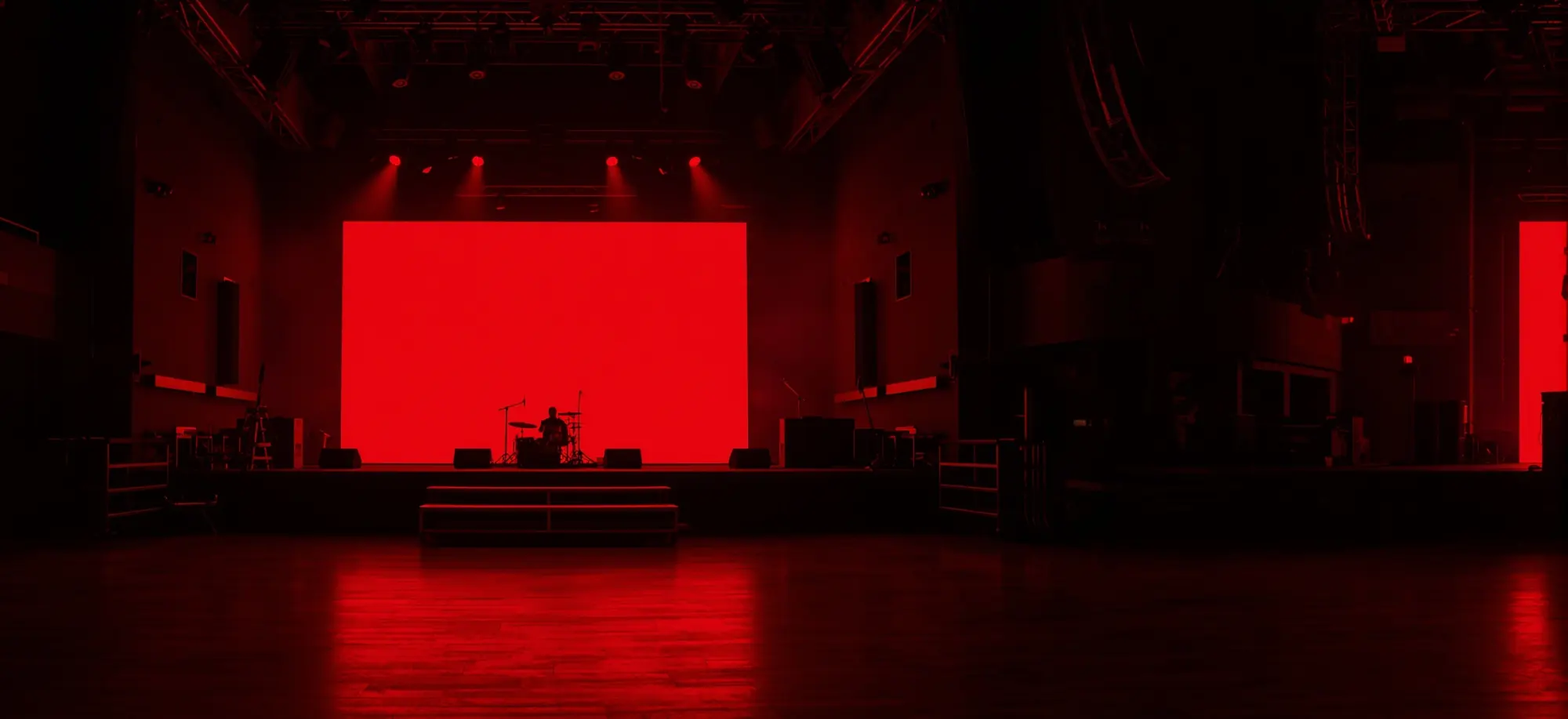
Most LED walls we install sit inside: behind a stage, over a bar, in a lobby or in a showroom. These aren't signs. They follow ordinary building and electrical rules, and the work is about picture quality, structure and power.
An exterior display, or one facing the street through a window, is a different path. In Surprise, that means checking the sign code first and designing around a monument or canopy sign where electronic messaging is allowed.
Pixel pitch and viewing distance
Pixel pitch is the distance between LED dots, in millimeters. A smaller pitch looks sharper up close and costs more. A wall viewed from across a room can use a larger pitch. We match the pitch to where your viewers stand, then confirm with a sample or a walkthrough of a similar wall.
- Lobbies and meeting rooms, viewed from a few feet: a fine pitch.
- Bars and restaurants, viewed from 10 to 30 feet: a medium pitch.
- Stages and large halls: a larger pitch, sized to the farthest seat.
Structure, power and cooling
An LED wall is a heavy set of cabinets. We check the wall or frame for load, plan a mounting frame, and bring dedicated power and data to the processor. The processor scales your sources to the wall, so a laptop, a media player or a camera feed all look right.
Service access matters too. We leave a way to reach panels from the front or the back, so replacing one doesn't mean taking the wall down.
Permits and inspections in Surprise
Surprise requires a construction permit for signs regulated by Chapter 109. The city's fee schedule lists a building or fire permit at $100 per permit plus $6 per $1,000 of valuation, with plan review at 65% of the permit fee, and a 0.50% administrative fee also appears. We did not find a separate sign permit fee line, and the schedule has no visible adoption date, so confirm current amounts with Community Development at 623-222-3000.
Permits lapse if work doesn't start within 180 days or stops for 180 days, so we schedule panels and installers before we pull one.
Content and control
We set up a simple playlist or a switcher so staff can change what shows without a tech. For a bar or stage, we tie the wall into your video distribution so game footage and graphics share one control.
Often paired with
LED walls often go in with event audio and video, digital signage and commercial audio. For the rest of our work in town, see Enzo in Surprise.