What to know about business WiFi in Scottsdale
The city names Old Town's busiest areas
The city names the Entertainment District, the 5th Avenue Shopping District and Stetson Avenue among Old Town's busiest areas. A full room of phones is a WiFi load, and a bar with hundreds of guests needs far more access points than the floor plan suggests.
Game days and event weeks bring more phones
The Giants' Cactus League home play at Scottsdale Stadium in Old Town begins Friday, February 19, 2027. A network sized for a normal Tuesday gets tested on game days and event weeks.
Source: Cactus League, Giants schedule
Wiring the access points is electrical work
The city says an electrical permit is required to install, alter or repair electrical wiring on any building, and its exemption list has no low-voltage exemption. Access points are powered over the network cable, so the cabling is the part the permit question applies to. We check with Permit Services at 480-312-2500.
The city has its own radio rules for buildings
Scottsdale prohibits installing or operating equipment that interferes, or is likely to interfere, with its public safety communications system. It also requires non-residential buildings to support the city's public safety radio system. That is separate from WiFi, but both are about radio coverage inside a building.
What good business WiFi looks like
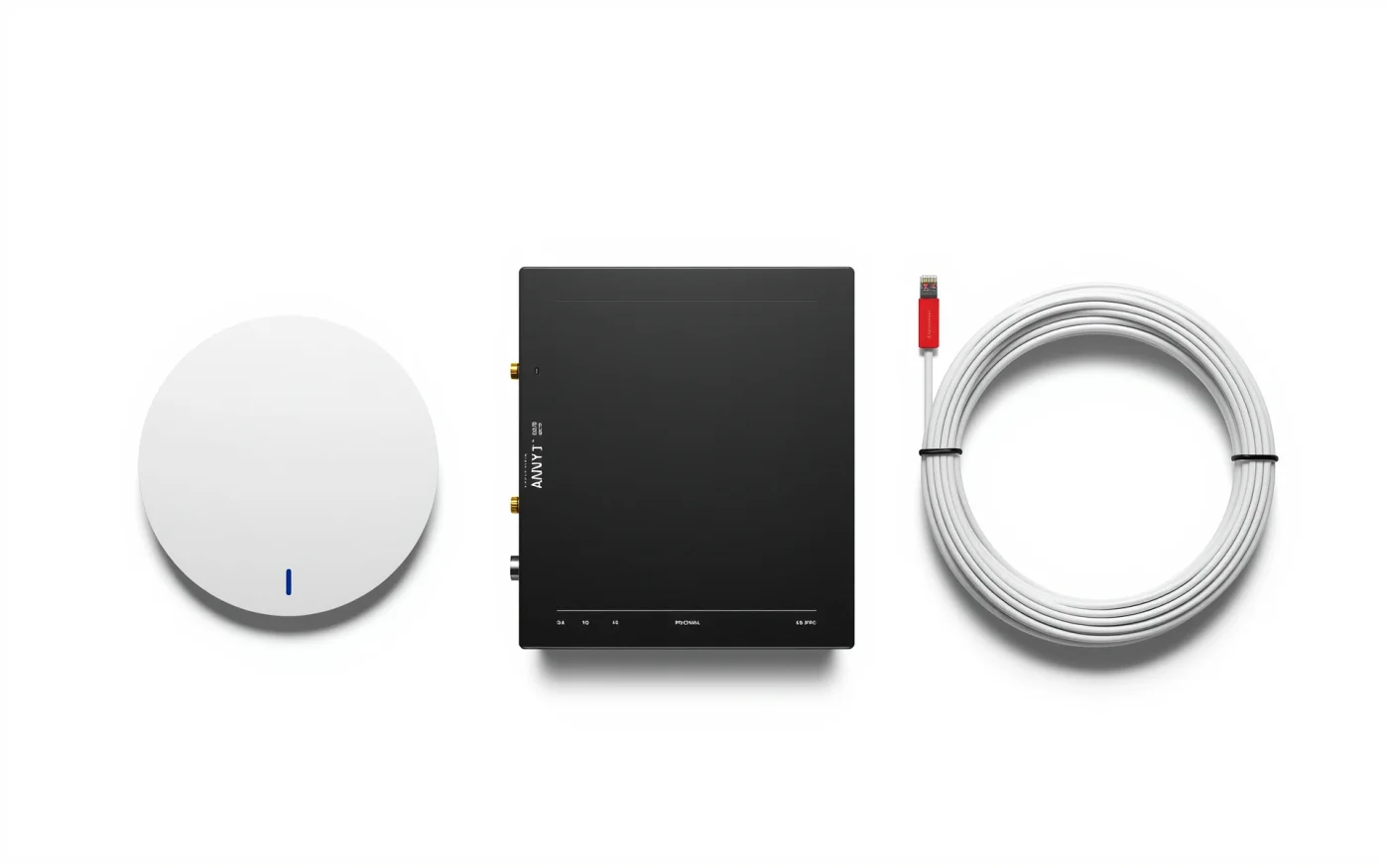
Good WiFi is many access points at low power, each wired to the network, not one strong router in a closet. Each access point covers a small area and hands devices off as people move. This is how coverage stays even in a long dining room, a patio or an open office.
Wired access points and the network behind them
Every access point gets a network cable, which also powers it through PoE. A switch in your rack provides the ports and the power. The wiring is the part people skip and later regret, because wireless links between access points slow everything down.
A business-grade router and switch sit behind the access points, so traffic is managed and one busy device doesn't slow the room.
Staff, guest and point-of-sale networks
We split the network into separate segments so guests can't reach your registers, printers or cameras. Typical splits:
- A guest network with a simple login or password and a speed limit per device.
- A staff network for laptops, phones and tablets.
- A point-of-sale network for registers and card terminals.
- A device network for cameras, music and TVs.
Patios, outdoor areas and thick walls
Outdoor access points are built for sun, heat and dust. A patio in Scottsdale needs one rated for it, mounted where it covers seating and not the parking lot. Block walls, stucco and metal studs absorb signal, so we walk the space and put access points where the signal is needed, not where it's easiest to hang them.
Capacity for crowded nights
Coverage is how far the signal reaches. Capacity is how many devices it serves at once. A bar can have full coverage and still be slow, because 300 phones share the same channels. We add access points, tune the channels and cap per-device speed, so a busy Friday works as well as a slow Tuesday.
Plan for your busiest night, including a ballgame or event week, not an average one. The city's calendar says WestWorld's Barrett-Jackson auction draws hundreds of thousands of attendees, and the 2027 auction is set for January 23.
Cabling underneath
WiFi depends on structured data cabling and works alongside security cameras and backup internet. The Scottsdale page has the rest. Call (602) 769-7992 and we will map your busiest night first.