What to know about structured data cabling in Chandler
Chandler's NEC amendments do not touch low-voltage cable
Chandler adopted the 2023 National Electrical Code in Ordinance 5108. Its only NEC amendments cover product listing, GFCI exceptions and tamper-resistant receptacles. None address low-voltage, plenum or abandoned cable, so the NEC applies as written and we cable to it.
Source: City of Chandler, amendments to the 2024 codes (29-3 to 29-3.5)
There is no low-voltage permit exemption
Chandler did not add a low-voltage exemption. Its electrical exemptions are an R-3 equipment swap and a catch-all that lets the Building Official exempt similar work. Questions go to the Plan Reviewer of the Day at 480-782-3078.
Source: City of Chandler, amendments to the 2024 codes (29-2.11)
Repeat work can run on an annual permit
The building official may issue an annual permit for alterations to an already approved site, instead of a permit for each change. For a business that adds cable drops several times a year, that is worth asking about.
Source: City of Chandler, amendments to the 2024 codes (29-2.8)
811 does not mark private lines
Arizona 811 requires two full working days of notice before digging. Utilities mark only what they own, up to the meter, so a private line such as site lighting or a parking-lot feed is not marked. That matters when a cable run crosses a yard or lot between buildings.
Source: Arizona 811
What structured cabling includes
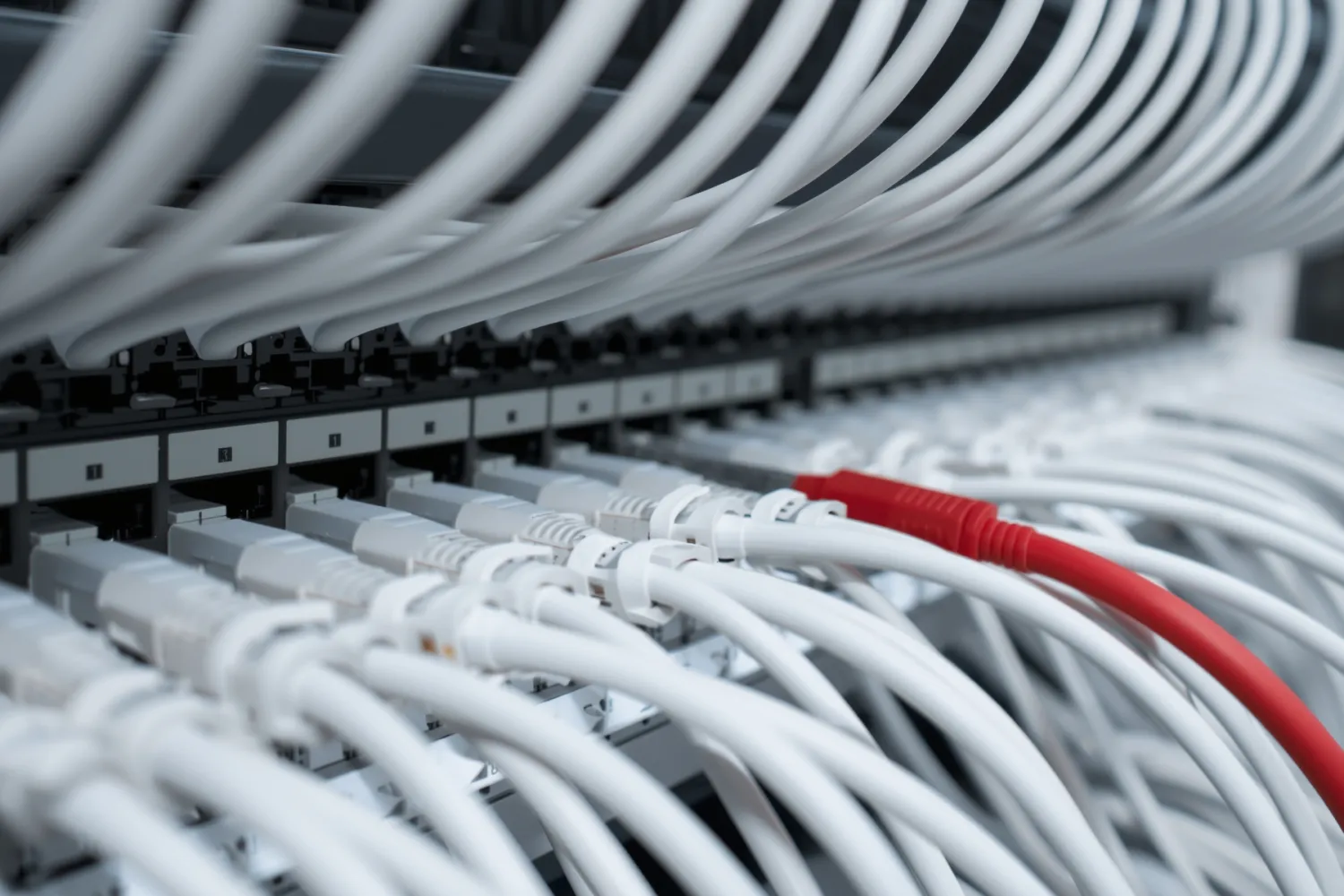
Structured cabling is a planned system, not a pile of cables. Each run goes from a wall jack or device location to a patch panel in a rack or closet, in a fixed layout you can read and extend.
A typical job includes:
- Cat6 or Cat6A cable to every drop.
- Jacks, faceplates and patch panels, each labeled to match.
- A rack or wall cabinet, with cable management.
- Network switches, with PoE where cameras, phones and access points need power.
- Fiber between closets or buildings where distance requires it.
- Test results for every run.
Cat6, Cat6A or fiber
Cat6 carries gigabit speeds to 328 feet and handles most offices, restaurants and shops. Cat6A is thicker and carries 10 gigabit over the same distance, which suits new builds, server rooms and long-life installs.
Fiber takes over past 328 feet, between buildings, or where electrical interference is a problem. We cover that on our fiber optic installation page.
Planning the layout
The best time to plan cable is before the walls are finished. Count drops generously. A restaurant needs drops for the POS stations, printers, cameras, WiFi access points, TVs and the office. A warehouse needs them for scanners, access points and dock cameras.
We put extra drops at the places you will want them later, since pulling one more cable while the ceiling is open costs far less than opening it again.
Testing, labels and documentation
Every run gets tested after termination, and the results are given to you. Each cable is labeled at both ends and matched on the patch panel, so you can trace any jack in seconds.
You also get a simple map of the building and the rack. When something fails in two years, whoever services it can find the cable without guessing.
Cabling in Chandler's office and industrial areas
The city says the Price Corridor along Loop 101 and Loop 202 holds about 41,620 jobs. Large office floors mean long runs between the rack and the far end of the floor, and sometimes several tenants on one riser. We plan pathways early, and we label each tenant's cable at the demarcation point, so the provider and your IT person know where their work stops and yours starts.
Older retail and restaurant spaces can have crowded ceilings and little room for new cable. A walkthrough shows what is possible.
Everything else rides on it
Business WiFi, security cameras and business phone systems all run on this cabling. Our other Chandler services are on Enzo in Chandler.