What to know about data cabling in Mesa
We build to the 2024 codes and the 2023 NEC
Mesa's 2024 International Codes and the 2023 National Electrical Code took effect on January 8, 2026. We build to those editions.
Low-voltage cabling isn't named on Mesa's permit page
The City lists tenant improvements, building electrical systems and safety systems such as alarms as needing permits, and says nothing specific about low-voltage cabling. On a remodel we ask Permit Services at 480-644-4273 how your project is treated before work starts.
Facilities with an annual permit skip individual permits
Mesa's Annual Facilities Permit exempts qualified facilities from individual permits for work that adds no floor area and does not change the use. It costs $800 per calendar year for the primary site and $350 per remote site. If you already hold one, tell us.
Drilling and pulling cable fit Mesa's noise hours
Construction and drilling are exempt from the noise chapter Monday to Friday, 6:00 a.m. to 8:00 p.m. We plan the loud part of a cabling job, such as core drilling, inside that window.
What structured cabling means
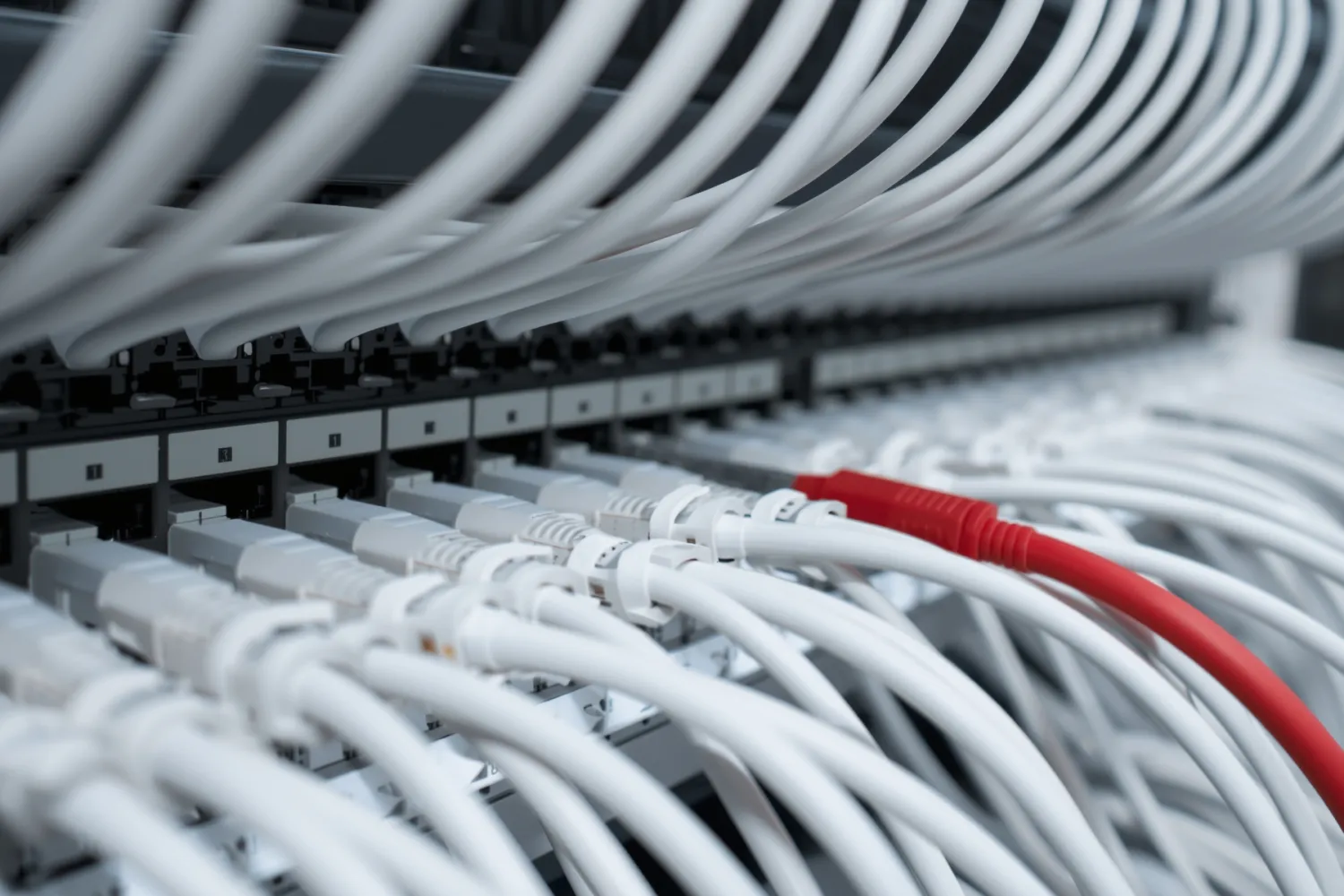
Structured cabling is one organized system instead of cables added whenever something new came in. Every drop runs from a wall jack or device back to a patch panel in a rack or closet, and a switch connects the panel to your network. Moving a desk, adding a camera or swapping a phone means changing a short patch cable, not pulling a new run.
Cat6, Cat6A and fiber
Cat6 handles most office, camera, access point and phone jobs at gigabit speeds and up to 100 meters. Cat6A handles higher speeds over the same distance and costs more per foot. Fiber is for long runs, between buildings or floors, and for the backbone between racks. See fiber optic installation for that side.
- Cat6 for desks, WiFi access points, cameras and phones.
- Cat6A where you expect 10-gigabit equipment.
- Fiber for runs over 100 meters or between buildings.
- Shielded or outdoor-rated cable where a run leaves the building.
Racks, panels and labels
Behind a good install sits a rack with a patch panel, a switch, and a plan on the wall. Every cable gets a label at both ends and a matching number on the panel. When something goes wrong at 7 p.m. on a Friday, you or a tech can find the right cable in seconds.
We leave room in the rack for growth and add cable management so nothing hangs loose.
Testing and documentation
Each run is tested with a cable certifier, not just a continuity tester. The report shows length, wiring and performance for every drop. You get the results and a floor plan that marks every jack.
Cabling in Mesa buildings and summers
Suites with open ceilings need J-hooks or tray, and slab floors may rule out running cable underneath. Warehouse buildings often need long fiber runs to keep a distance under the copper limit. We look at each ceiling, wall and closet before we price the job.
Heat matters too. Mesa attics and rooftop runs get hot enough to age ordinary cable jackets, so cable that leaves the conditioned space is rated for it and stays out of direct sun. Arizona State Parks lists monsoon season as June 15 to September 30, so outdoor runs get sealed connections and drip loops.
Often paired with
Cabling goes in ahead of business WiFi, security cameras and business phone systems, since all three plug into it. Our other Mesa work is on Enzo in Mesa.