What to know about structured data cabling in Queen Creek
Each tenant space gets its own permit application
The Town requires a separate building permit application for each commercial tenant space, submitted online with electronic plans. A new restaurant or office in a shared center files for its own space. If you want a fee estimate before you submit, the Permit Technician line is 480-358-3050.
Low-voltage data wiring is on the exemption list
The Town's electrical exemptions include low-energy Class II and Class III power, control and signal circuits, and equipment under 27 volts that cannot supply more than 50 watts. Data cabling may fall under that wording, but the Town says the Building Official decides. Outlets and circuits for the rack are not covered. Call (480) 358-3009 to confirm for your job.
Source: Queen Creek amendments to the 2021 codes, Town Code 7.1.4.2.3
The Town lists the 2020 National Electrical Code
The Town's Building Codes page lists the 2020 National Electrical Code and the 2021 International Fire Code. The page is undated, and we found no newer adoption, so check with Building Safety before a design is final. Cable type matters here: cable in a ceiling air-handling space must carry the right fire rating.
Source: Queen Creek Building Codes page
Every door, roll-up and roof hatch goes on the fire plan
Fire pre-incident floor plans must show all ingress and egress doors, including roll-up doors and roof hatches, along with alarm panels and key boxes. Cable paths should not block or crowd these. We route around them and mark panels on our own drawing.
Source: Queen Creek fire code amendment, preplan floor plans
What structured cabling is
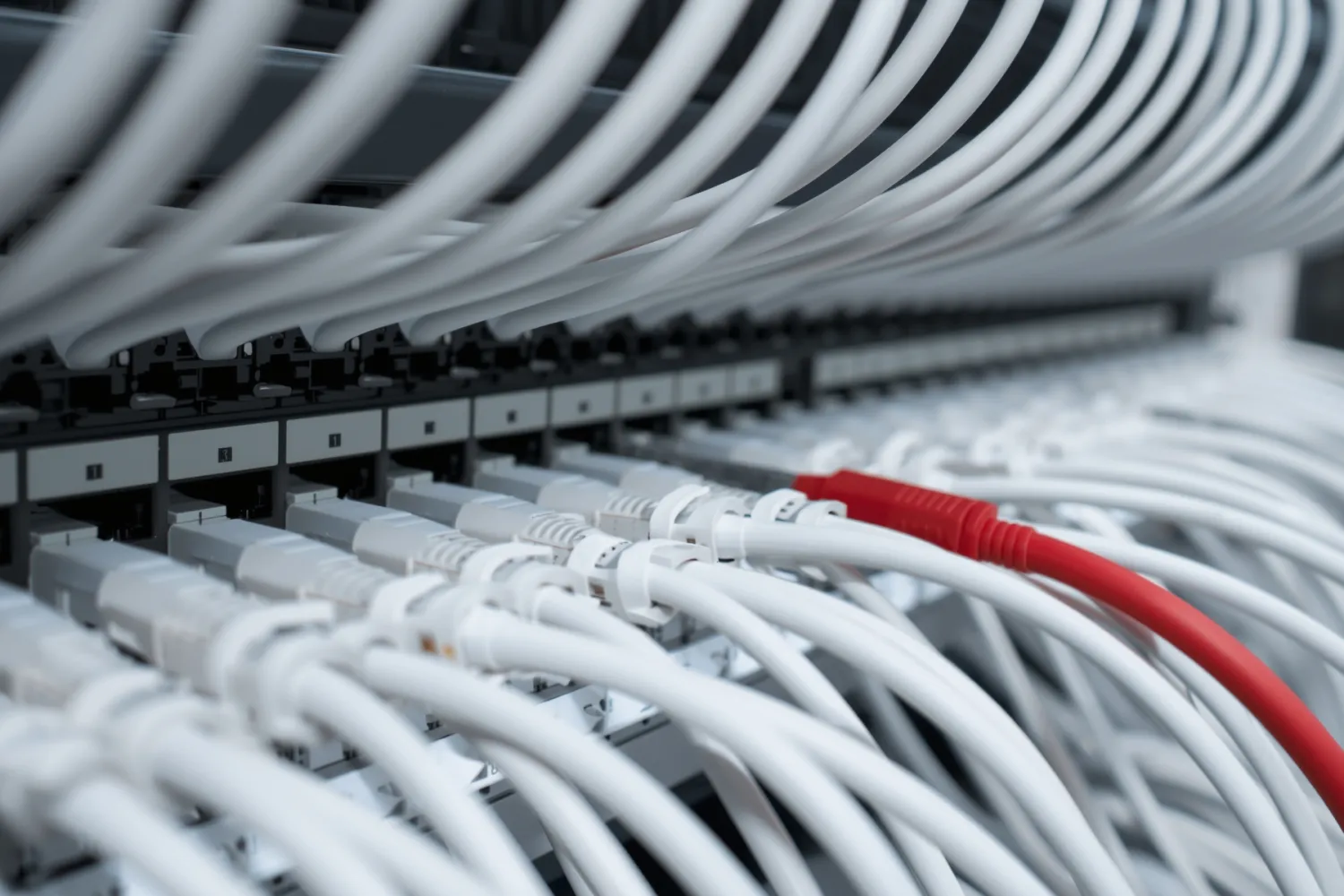
A structured cabling system has three parts. Cables run from a central rack to wall jacks or devices. The rack holds a patch panel where every cable ends, plus the switch and router. Short patch cords connect the panel to the switch.
That layout lets you move a device by changing a patch cord instead of pulling a new cable. When something fails, a label tells you which cable it is.
Cat6, Cat6A and fiber
Cat6 handles gigabit speeds to a full 100 meters and is the usual choice for desks, phones, cameras and access points. Cat6A costs more and is thicker, but it carries 10 gigabit over the same distance, which suits a server room or a heavy-use access point. Fiber is for long runs between buildings or closets and for places with electrical noise. See our fiber optic installation page for that.
- Count the drops: desks, TVs, phones, printers, registers, cameras, access points.
- Plan extras. A spare jack costs little during the install and a lot afterward.
- Keep each run under 100 meters from the rack.
- Use plenum-rated cable in air-handling ceiling spaces.
Racks, panels and labels
We put the equipment in a wall-mount or floor rack with a patch panel, cable management and power. In a restaurant that often means a closet near the office or a shallow wall cabinet. We choose a place with room for cooling, because Arizona heat in a back room can shorten the life of switches.
Every cable gets a number at both ends, and the same number appears on the panel. You get a printed list of what each number is.
Cabling for new Queen Creek spaces
Cabling timing matters most in new restaurant space. The Town's economic development list names restaurant and bar tenants planned for Downtown at the northeast corner of Ellsworth Loop and Ocotillo, and other restaurant areas at Queen Creek Marketplace, Queen Creek Road and Ellsworth, The Madera at Signal Butte and Queen Creek, and Harvest Station. The list is undated and gives no opening dates.
Cable is cheapest to run before ceilings close. If you are in a buildout, send us the plans as soon as the permit application is in, and we will mark drop locations for registers, TVs, phones, cameras and access points.
Testing and handoff
- We test every run for continuity and length, and certify to speed when you need it in writing.
- You receive a labeled drawing and the test results.
- We show your IT person or manager where everything lands.
- Service stays local, Monday to Friday, 8 AM to 5 PM.
Often paired with
Cabling is the base for business WiFi, phone systems and security cameras. The full town list is on Enzo in Queen Creek.