What to know about data cabling in Glendale
Cabling through fire-rated walls follows the 2024 codes
Glendale's 2024 building and fire codes took effect January 9, 2026, and plans submitted after July 9, 2026 must comply with them. Cabling that passes through fire-rated walls and ceilings is built to those editions.
Source: City of Glendale, 2024 Building Code implementation memo
We found no Glendale rule specific to low-voltage cabling
The city's building permit Q&A says extending an electrical circuit or adding outlets needs a permit, but it is written for homeowners and says nothing about data or AV wiring. We found no separate low-voltage rule on the city's pages. For a job that includes new power or a tenant improvement, we call Development Services at 623-930-2800 first.
Permits that sit unused expire in 180 days
When a job does need a Glendale building permit, it expires if work has not begun within 180 days of issue, and an inspection must pass every 180 days to keep it active, up to a 2-year limit. That affects scheduling when cabling is one step in a longer build-out.
Historic buildings: interior work is treated differently
In Glendale historic districts and on historic properties, exterior work that needs a building permit requires a Certificate of No Effect or Appropriateness. Interior work does not. Cabling inside an older building is generally an interior job, but a new exterior conduit run may not be.
What structured cabling includes
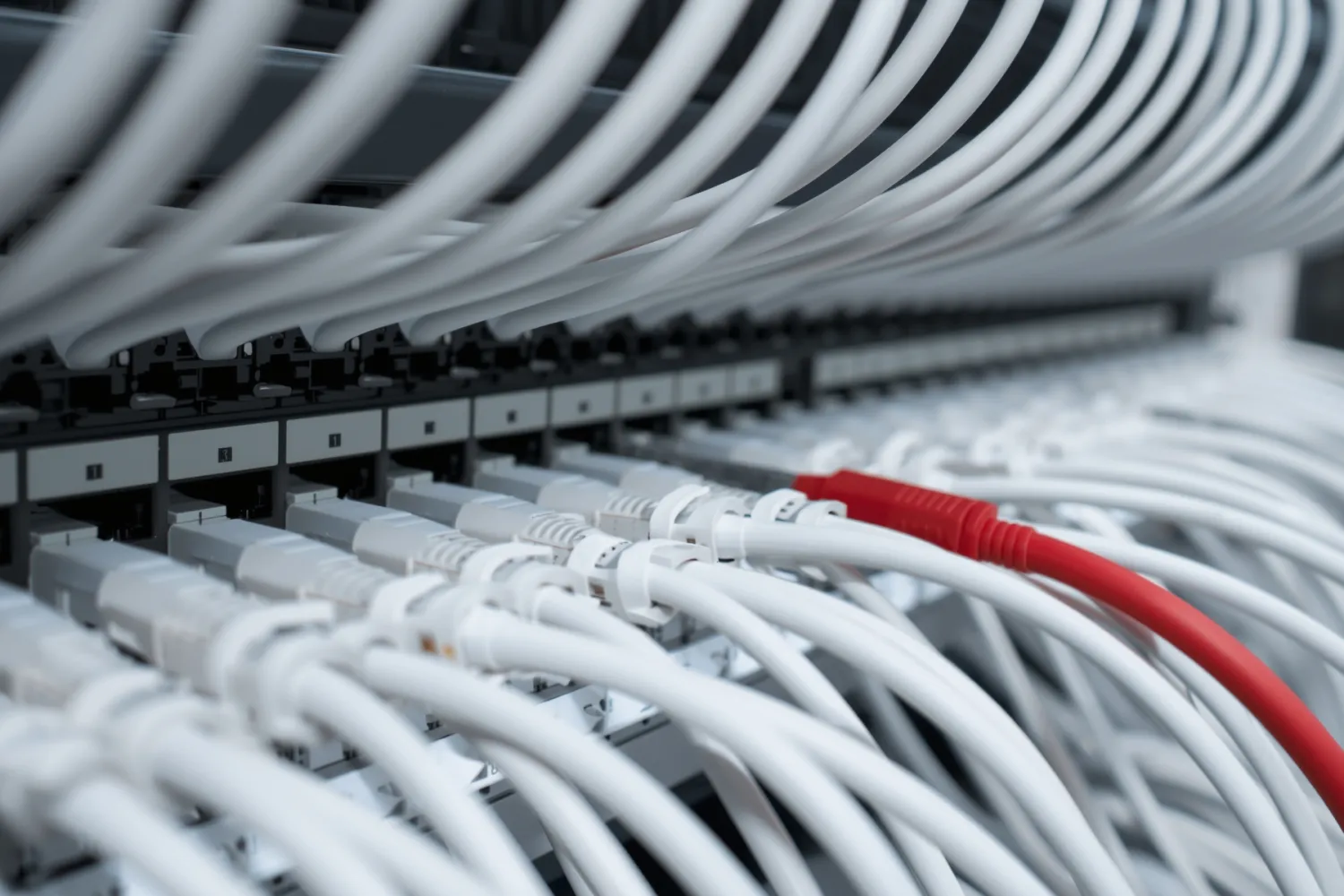
Structured cabling is a planned system, not a pile of cables. It has the cable runs from each wall jack or device back to a central point, the patch panel they end on, the rack that holds the panel and switches, and the patch cords between them.
Every run is labeled at both ends and tested. You get a list showing which jack goes to which port, so the next person to touch the network does not have to trace anything.
Cat6, Cat6A or fiber
Cat6 handles most office and restaurant needs, including 1 gigabit and 10 gigabit over shorter runs. Cat6A holds 10 gigabit at the full 100 meters and shields better against interference, which matters in a crowded ceiling. Fiber suits long runs between buildings or floors.
A run is limited to 100 meters, counting the whole path from switch to device, so we place the rack so every run stays inside that limit.
Where the cable goes
We plan drops for what you have today and what you will add. Common places are:
- Access points on ceilings, on the patio and in the back of house.
- Cameras at doors, registers and lots.
- Point-of-sale terminals, printers and kitchen display screens.
- TVs and digital signage, so each display has a wired feed rather than a WiFi signal.
- Desk drops, phones and a conference table.
Older Glendale buildings and warehouses
Retrofit work is where cabling gets tricky. Old buildings may have plaster ceilings, tight attics, block walls and slab floors, and a warehouse may need a lift for a high ceiling. We plan routes before quoting so the job holds no surprises.
New work submitted now follows the 2024 codes, even if your space was built under an older one. We seal penetrations through fire-rated walls and ceilings.
How a cabling job runs
- We walk the building to pick the rack location, cable paths and ceiling access.
- The quote lists every drop and its label.
- Cable is pulled and terminated, usually after hours.
- We test every run and hand over a test report and a labeled rack.
- Service calls run Monday to Friday, 8 AM to 5 PM.
What plugs into the cabling
Cabling feeds business WiFi, security cameras and business phone systems. When two buildings need a link, we add fiber. The rest of our Glendale work is on the Glendale page. Call (602) 769-7992 to book a walkthrough.