What to know about data cabling in Tempe
New work follows the 2023 NEC
Tempe adopted the 2024 I-Codes and the 2023 NEC with local amendments, effective July 1, 2026. Through December 31, 2026 a permit application can be filed under either the 2018 or the 2024 codes. From January 1, 2027 every application must meet the 2024 codes and the 2023 NEC. For a tenant improvement, we plan cabling to the newer editions so it passes whichever you file under.
Source: City of Tempe Building Safety
Low-voltage and the permit exemption
Tempe's Administrative Code requires a permit before anyone installs, alters or repairs a regulated electrical system. Its exemption list includes Class 2 and Class 3 control and signal circuits not essential to human life. The city does not say which data, camera or AV systems qualify. We ask the Permit Center at 480-350-4311 on your project, and applications are filed online.
Mill Avenue has new tenants
Tempe finished its Mill Avenue streetscape rebuild from University Drive to Rio Salado Parkway, and the city lists about 30 businesses opened on or near Mill in 2025 and 2026. A new tenant space often has no cabling at all or someone else's, so we start with a survey of what's in the walls and ceilings.
Drilling and coring have hours
Tempe's noise code limits construction and repair work. In commercial zones more than 500 feet from a residential zone, work may start at 5 a.m. and must stop by 7 p.m. Near homes, the start is 6 a.m. from April 15 to October 15 and 7 a.m. the rest of the year, and weekends and holidays run 7 a.m. to 7 p.m. State law also limits city noise rules on permitted construction in summer, so we plan around the strictest reading.
Source: Tempe City Code Sec. 20-8
What structured cabling means
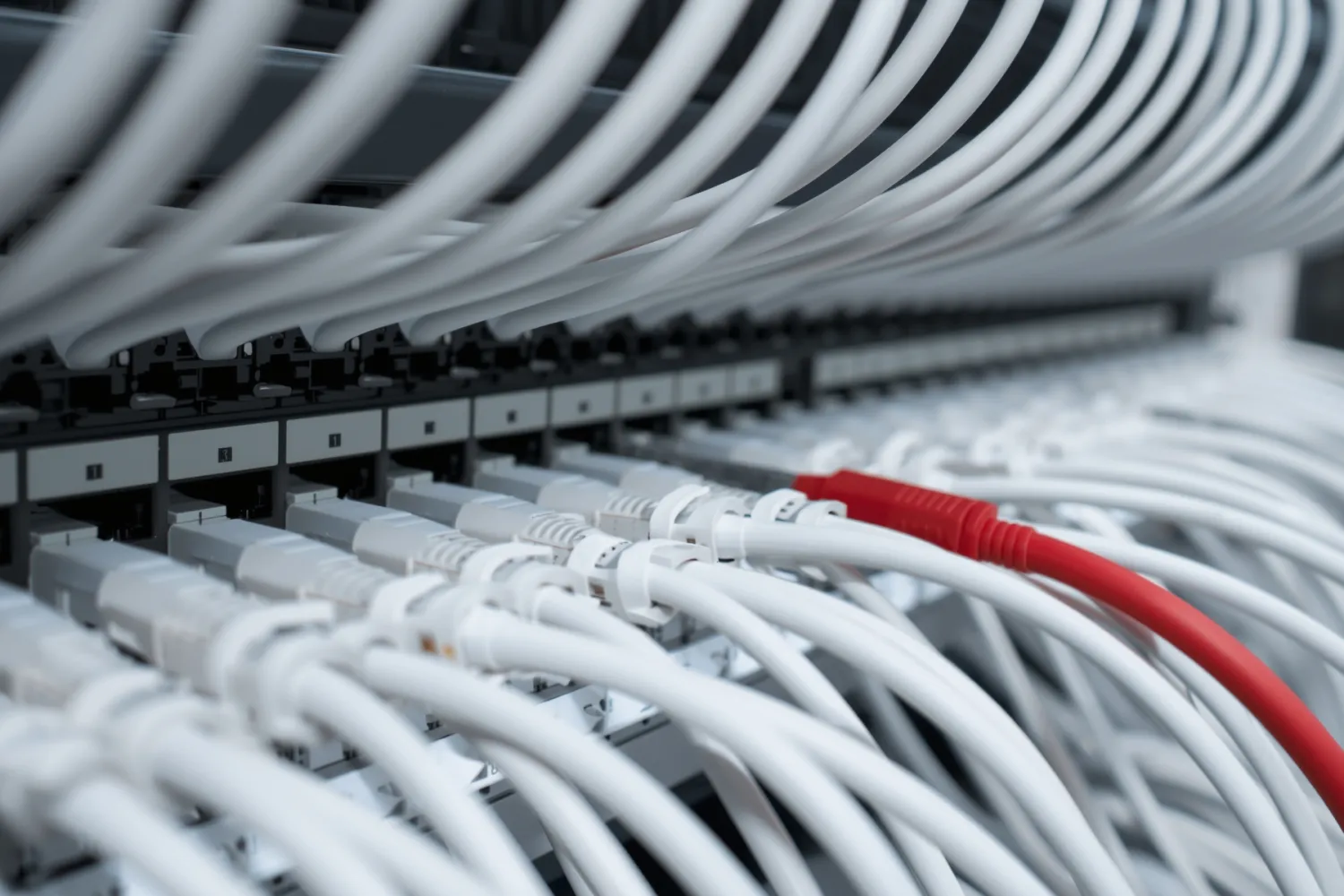
Structured cabling is a single organized system. Every jack at a desk, wall or ceiling returns to a patch panel in a rack or closet. From there, a short patch cable connects it to the switch. Move a desk or add a printer, and you change a patch cable instead of pulling new wire.
The parts are the cable, the jacks and faceplates, the patch panels, the rack and the labels. Each jack and each port carries the same number, so a fault can be traced in minutes.
Cat6, Cat6A and fiber
Cat6 handles gigabit speeds to 328 feet and 10 gigabit over shorter runs. Cat6A handles 10 gigabit over the full 328 feet and is more shielded from interference, but the cable is thicker and stiffer, so it needs bigger pathways and bend radius. Most offices and restaurants do well on Cat6, with Cat6A for wireless access points, cameras that will be upgraded and runs likely to carry more later.
Between floors, buildings or distant closets, fiber optic cable is the better choice. It carries more, travels farther and isn't affected by electrical noise.
What gets installed
- Drops to each desk, wall, ceiling access point, camera, TV and phone location.
- Patch panels, a rack or wall cabinet, cable management and, where needed, a ladder or tray in the ceiling.
- Firestop where cable passes through a rated wall or floor.
- Testing of every run and a report you keep, with the results for each cable.
- Labels on both ends of every cable, and a simple map of where each one goes.
Cabling for restaurants, shops and offices
Restaurants usually need drops for registers, kitchen display screens, printers, access points, cameras and music or TV equipment. Retail adds payment terminals and signage players. Offices add desk drops, conference room connections and phone ports.
We plan spare drops where you might expand: an extra jack behind a bar, one more at a manager's desk. Putting those in while the ceiling is open costs much less than opening it again.
Working in an occupied Tempe building
Most of our cabling is in space that is already in use. We plan the pathway first, protect floors and furniture, and schedule loud work such as coring and drilling for hours that suit you and fit the city's construction hours. Older buildings often have block walls, plaster or crowded ceilings, so a walkthrough before the quote avoids surprises.
Often paired with
Cabling is the base for business WiFi, security cameras and business phone systems. Browse the rest of our Tempe services at Enzo in Tempe.